How Wire Straightener Machines Set the Stage for Accurate Tensile Testing
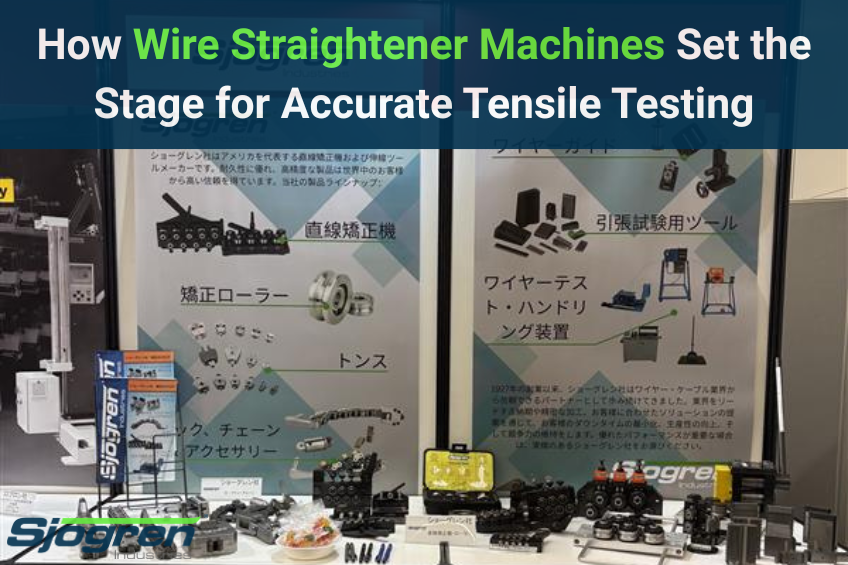
When tensile testing produces inconsistent results, most teams look at the machine settings or the material certification first. What often gets overlooked is what happened to the wire before it ever reached the test station. A wire straightener machine plays a direct role in how material behaves under load, and its impact carries all the way through the line.
Tensile testing reflects the condition of the wire at the moment force is applied. If internal stress, curvature, or uneven tension were introduced earlier in the process, testing will expose it. In many cases, inconsistent data isn’t a testing issue at all. It’s a straightening issue that began upstream.
What We’ll Cover:
- What does a wire straightener machine actually do?
- Residual stress: the hidden variable in tensile testing
- How straightening impacts wire puller performance
- Choosing the right wire straightener tool for your application
- Common signs your wire straightener machine is affecting test data
- How straightening, pulling, and testing form one system
- Key takeaways
- Contact Sjogren Industries
What Does a Wire Straightener Machine Actually Do?
A wire straightener machine removes cast and helix while reducing residual stress left behind from drawing or coiling. By passing material through a series of offset rolls, a wire straightener forces controlled deformation that brings the material back into a neutral, balanced state. When properly adjusted, the wire exits centered, stable, and ready for the next operation.
A wire straightener tool is more than a mechanical fixture. Roll configuration, spacing, and pressure determine how evenly the correction is applied. If the settings are too aggressive, the material becomes overworked. If too light, curvature remains. In both cases, the wire puller downstream must compensate for instability, and that compensation shows up later during tensile testing.
Residual Stress: The Hidden Variable in Tensile Testing
Improper straightening leaves behind residual stress that isn’t visible. The wire may appear straight, but it still carries an internal imbalance across its cross-section. During tensile testing, that imbalance affects elongation behavior, necking location, and fracture pattern.
This oversight is why two samples from the same coil can produce slightly different tensile testing results. The variation may not be a metallurgy problem. It may be the result of how the wire straightener machine was set up that day. Even small roll adjustments influence how stress redistributes across the wire’s diameter.
When tensile testing shows premature fracture or inconsistent yield strength, reviewing the straightener setup should be part of the diagnostic process. Testing does not create defects. It reveals them.
How Straightening Impacts Wire Puller Performance
A wire puller assumes the material entering it is balanced and centered. When a wire leaves a wire straightener unevenly corrected, the puller grips material that already carries directional stress. That imbalance can cause subtle lateral movement during pulling, increasing wear on the jaws and altering load consistency.
Over time, this affects more than just mechanical stability. It influences how evenly tension is applied before samples reach tensile testing. If pulling force fluctuates because the material enters off-center, those fluctuations contribute to data variability.
Stable pulling depends on stable input. When the wire straightener is tuned correctly, the wire puller operates within its intended parameters. When straightening is inconsistent, the puller compensates, and that compensation changes how the material performs under test.
Looking for quality wire testing you can trust?
Learn MoreChoosing the Right Wire Straightener Tool for Your Application
Selecting the right wire straightener tool requires understanding the diameter range, material hardness, and surface sensitivity. A tool designed for heavy-gauge material may overcorrect smaller wire. Conversely, a straightener designed for light wire may not provide sufficient correction for high-tensile applications.
Roll count and configuration also matter. More rolls allow finer correction control, but they require careful calibration. Quick-adjust mechanisms can improve repeatability between operators, especially in facilities running multiple material types.
When properly matched to the application, the right wire straightener tool reduces variation before tensile testing even begins. That stability improves repeatability and reduces the need for retesting. Good straightening does not just improve line performance. It improves data quality.
Common Signs Your Wire Straightener Machine Is Affecting Test Data
Several indicators suggest straightening is influencing tensile testing outcomes:
- Inconsistent elongation readings across identical samples
- Fracture occurring outside the expected gauge length
- Small shifts in yield strength without changes in material source
- Increased variability between operators or shifts
When these signs appear, the wire straightener machine should be evaluated alongside the test equipment. Roll wear, alignment drift, and improper roll spacing all contribute to residual stress. Addressing these factors often stabilizes tensile testing results without changing material suppliers or wire machine calibration.
How Straightening, Pulling, and Testing Form One System
A wire straightener, wire puller, and tensile testing station are not isolated steps. They form a continuous system where each stage influences the next. When straightening introduces imbalance, pulling amplifies it. When pulling fluctuates, testing reveals it.
Improving one stage without reviewing the others limits long-term gains. Process stability comes from aligning all three components. When the wire straightener delivers balanced material, the wire puller maintains consistent force, and tensile testing produces reliable data that reflects true material properties.
Seeing the line as one system rather than separate stations leads to smarter diagnostics and better long-term consistency.
Upgrade your wire tooling process today
Schedule a ConsultationKey Takeaways
- Tensile testing accuracy depends heavily on upstream straightening quality.
- A wire straightener machine removes curvature and redistributes residual stress, directly affecting test performance.
- Improper straightening introduces hidden stress that shows up during tensile testing.
- Wire puller stability depends on balanced, centered input from the straightener.
- Choosing the right wire straightener tool reduces downstream variation and improves repeatability.
- Inconsistent test results often trace back to the setup rather than material defects.
Work With Sjogren Industries to Strengthen Your Entire Line
Accurate tensile testing starts long before the sample enters the machine. It begins with stable, controlled straightening and consistent pulling. Sjogren Industries supports manufacturers with precision-engineered wire straightener machines, durable straightener tools, and reliable wire puller solutions built for long-term performance.
If you are seeing unexplained variation in tensile testing or want to strengthen consistency across your operation, it may be time to review your upstream process. Contact us today or follow us on LinkedIn to improve testing accuracy, protect your equipment, and keep your production running with confidence.
Related Posts

| March 26, 2026
Wire quality does not begin at the test bench or at final inspection. It starts much earlier, at the first…
>
| January 20, 2026
In tensile testing, accuracy depends on more than the machine itself. Even the most advanced tensile testing machines can produce…
>
| December 15, 2025
A failed torsion test can feel like a setback, but in most cases, it's simply your process needing an audit.…
>