How Bend Testers Help Validate Wire Performance Before Production Runs
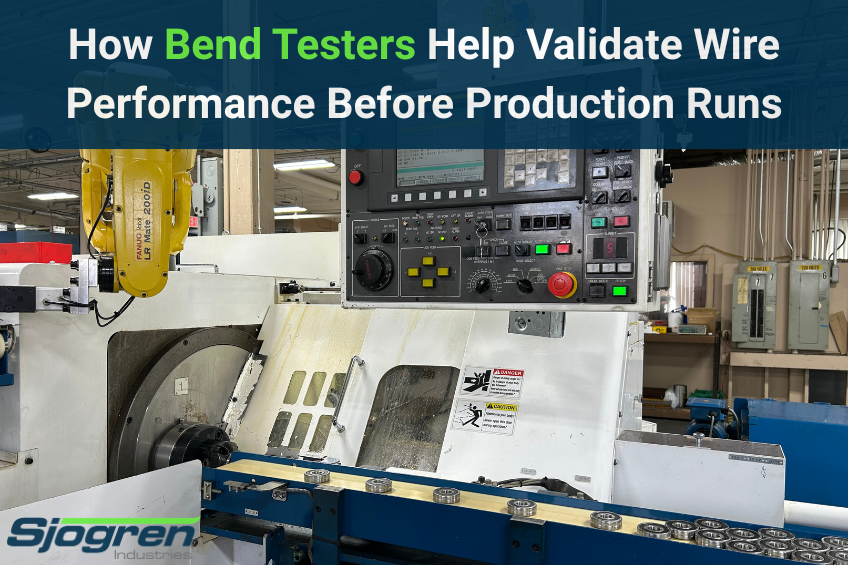
Small material issues rarely stay small once production begins. A flaw that goes unnoticed at the start of a run can turn into scrap, downtime, extra labor, or a customer complaint by the end of it. That’s why early validation matters. Bend testers give manufacturers a practical way to confirm how wire will behave before committing machine time, operator attention, and valuable material to a full production run.
This step matters even more when the wire will later move through forming, straightening, or wire pulling operations, where stress builds quickly. In this blog, we’ll look at how bend testing helps validate performance before production starts, how it connects to upstream and downstream equipment like a wire guide and wire straighteners, and why that information helps manufacturers make better decisions with more confidence.
What We’ll Cover:
- What bend testers actually tell you about wire
- Why early testing saves time, scrap, and downtime
- How straightening and guiding affect bend test results
- Where tensile jaws fit into the bigger validation process
- Common warning signs that a bend test should not be ignored
- Why bend testing supports better production decisions
- How Sjogren helps manufacturers validate with confidence
- Key takeaways
- Contact Sjogren Industries
What Bend Testers Actually Tell You About Wire
Bend testers help answer a simple but important question before production begins: how will this wire behave under stress? More specifically, it shows whether the material can flex without cracking, splitting, or failing in ways that would create problems later on. That makes it a valuable checkpoint for validating consistency before the wire reaches downstream operations.
Unlike tensile testing, which measures strength under direct pull, a bend tester reveals how the material responds when it is forced through repeated or controlled deflection. That response can expose brittleness, coating breakdown, or hidden weakness that may not be obvious during visual inspection. In that sense, bend testing does not replace other methods. It adds another layer of clarity. For manufacturers trying to avoid scrap, poor forming performance, or unreliable finished parts, that kind of early feedback is worth having before the first production run begins.
Why Early Testing Saves Time, Scrap, and Downtime
Once a production run is underway, even a small material issue can become expensive fast. Wire that looks fine at the start may begin to crack, deform, or behave unpredictably once it is under real process stress. That can lead to scrap, machine stoppages, and extra troubleshooting that eats into both time and margin.
This process is where early validation makes a difference. If a bend tester shows that the material cannot handle the expected flex or stress before production starts, the team has a chance to pause, investigate, and correct the issue before more value is added to the part. The same is true when problems later show up during wire pulling. A failed pull is often the result of conditions that could have been flagged earlier through testing. Catching those warning signs before the run begins is far less costly than reacting once the line is already moving.
Looking for quality wire testing you can trust?
Learn MoreHow Straightening and Guiding Affect Bend Test Results
A bend test rarely reflects raw material alone. In many cases, it also reflects what happened to the wire before it reached the tester. If wire straighteners are set too aggressively, they can leave behind stress that weakens the material during bending. If they are set too lightly, they may leave a cast or helix that affects how evenly the wire responds under load. Either way, the bend test ends up showing the result of the process, not just the wire.
The same is true for a wire guide. If the material is not entering and exiting key stages in a controlled, centered path, it can pick up surface marking or uneven stress that later shows up during testing. That is why bend testing is so useful. It often brings upstream setup issues into view before they become production problems. When bend results start to vary, the straightening and guiding setup is one of the first places worth checking.
Where Tensile Jaws Fit Into the Bigger Validation Process
Bend testers and tensile jaws do different jobs, but they support the same goal: proving that the wire will perform the way it needs to before production begins. Bend testing shows how the material reacts to flexing and repeated stress. Tensile jaws support testing that measures how the wire behaves under direct pulling force. One helps confirm flexibility and resistance to cracking. The other helps confirm strength, elongation, and load response.
Used together, they give manufacturers a more complete picture of wire performance. A sample might bend cleanly but still fail under tension, or it may pass a pull test and still crack when flexed. That is why validation works best when these methods are treated as complementary, not interchangeable. Looking at both sets of results before a run begins helps reduce uncertainty and gives production teams more confidence in the material they are about to process.

Common Warning Signs That a Bend Test Should Not Be Ignored
Some bend test failures are obvious. Others are easier to dismiss, especially when production pressure is high, and the material looks acceptable at a glance. But repeated cracking, coating breakdown, uneven bend response, or early fracture are all signs that something in the process deserves a closer look. Those results often point to issues that will become more expensive once the wire reaches forming, assembly, or wire pulling.
This precaution is why failed or inconsistent bend tester results should be treated as useful process feedback, not just a lab problem. In many cases, the test reveals stress, marking, or imbalance introduced upstream. Ignoring those signs usually means the same issue will show up later in a more disruptive way. When bend performance starts to vary, it is a signal to check handling, setup, and equipment condition before moving forward with a full run.
Why Bend Testing Supports Better Production Decisions
Good testing does more than confirm whether the material passes or fails. It helps manufacturers decide what to do next. A clean bend result gives the team confidence to move forward. An inconsistent one can justify pausing the run, reviewing the setup, or isolating a questionable lot before more time and material are committed. That makes bend testing a practical decision tool, not just a lab exercise.
Its value grows even more when it is viewed alongside the rest of the process. Results from tensile jaws help confirm how the wire responds under direct load, while output from wire straighteners and the path through a wire guide help explain why the material behaved the way it did during bending. When those pieces are reviewed together, production teams get a clearer picture of whether the issue is material, setup, or equipment related. That kind of clarity leads to better choices before the line ever starts moving.
Upgrade your wire tooling process today
Schedule a ConsultationHow Sjogren Helps Manufacturers Validate With Confidence
Sjogren Industries helps manufacturers look at testing as part of the full production process, not as a separate step at the end. Our equipment and tooling are built to support more reliable validation before a run begins, so customers can catch problems early and move into production with more confidence. That includes solutions tied to bend testing, handling, straightening, and tensile setups.
Because we work across multiple stages of the line, we understand how test results connect back to real process conditions. A problem that shows up on a bend tester may trace back to a guide, a straightener setting, or a handling issue upstream. The same is true when tensile jaws reveal unexpected variation under load. Sjogren helps manufacturers connect those dots with tooling and support that improve consistency, reduce guesswork, and strengthen decision-making before production starts.
Key Takeaways
- Bend testers help validate wire performance before production begins, when problems are still easier and less expensive to fix.
- Early testing reduces the risk of scrap, downtime, and avoidable troubleshooting once the line is running.
- Wire straighteners and a properly set wire guide influence how material performs during bending, even before forming begins.
- Tensile jaws and bend testing support different parts of the validation process, but they work best when used together.
- Better pre-production testing leads to better production decisions, stronger consistency, and more confidence in every run.
Work With Sjogren Industries Before Problems Reach the Line
Wire manufacturers need more than test results. They need confidence that those results reflect real production conditions. Sjogren Industries helps customers strengthen that confidence with testing tools, tensile jaws, straightening solutions, and the process knowledge to connect all of it back to line performance. If you want to catch problems before they turn into downtime, scrap, or customer complaints, work with Sjogren to build better validation into the start of every production run.
Contact us today or follow us on LinkedIn to request pricing and upgrade your wire performance.
Related Posts

| September 23, 2026
Your operators know the routine. Adjust the bend, check the part, and correct it again. Meanwhile, new orders keep coming.…
>
| July 21, 2026
Accurate bend testing depends on more than the tester itself. The way operators guide, handle, and secure a sample before…
>
| June 16, 2026
In wire production, the equipment you rely on directly impacts performance, product quality, and profitability. Whether you're processing high-tensile materials,…
>