When Should You Upgrade to a CNC Wire Bender Machine?
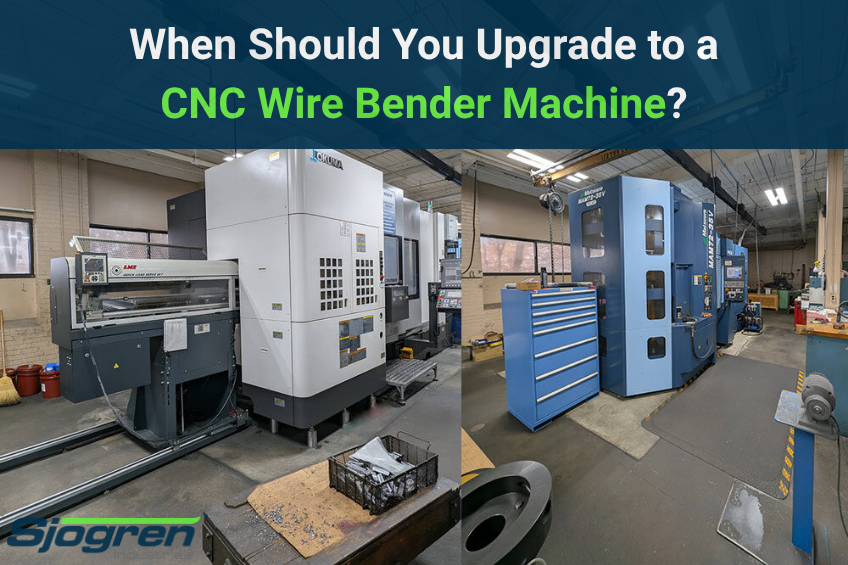
Your operators know the routine. Adjust the bend, check the part, and correct it again. Meanwhile, new orders keep coming. If that cycle slows production, it may be time to consider a CNC wire bender machine.
Start by identifying what holds your line back. Look for capacity limits, inconsistent parts, or lengthy changeovers. Then evaluate the bender and the tooling that prepares wire for it. An upgrade should deliver measurable improvements that justify the cost.
What We’ll Cover:
- What does a CNC wire bender machine do?
- Production demand exceeds your bending capacity
- Dimensional variation creates too much rework
- Complex parts and repeat orders consume setup time
- Check your wire straightening tool before you upgrade
- Compare the full cost with the expected production gains
- Use contract manufacturing to support your upgrade
- Key takeaways
- Contact Sjogren today
What Does a CNC Wire Bender Machine Do?
CNC stands for computer numerical control. In a CNC bending system, programmed motion controls operations such as feeding wire and forming bends. Operators enter or load part specifications, then the machine follows the programmed sequence.
That control helps a wire bender machine repeat shapes and handle complex bending sequences with less manual intervention. Every system has limits, though. Match its wire diameter range, material capabilities, tooling, and available motion to the parts you actually produce. Keep reading to learn 3 signs your line could benefit from an upgrade.
1) Production Demand Exceeds Your Bending Capacity
If jobs pile up at the bending station while other operations wait, investigate your available capacity. Track output per shift, handling time, and overtime across representative jobs.
Those numbers help separate a recurring equipment limitation from a temporary scheduling problem. If bending consistently restricts output, CNC automation may help your team keep pace. Confirm that upstream preparation and downstream operations can support the added capacity, too.
2) Dimensional Variation Creates Too Much Rework
Repeated corrections to bend angles, lengths, or finished shapes consume labor and material. Review inspection records to identify where variation starts and which jobs generate the most scrap.
Programmable motion can improve repeatability, but material variation, worn tooling, and poor setup still affect results. Ask potential equipment suppliers to run representative parts using your production wire. Measure finished parts against your actual tolerances before deciding.
3) Complex Parts and Repeat Orders Consume Setup Time
Parts with multiple bends and frequent changeovers can tie up experienced operators. Repeat orders become especially frustrating when each setup starts from scratch.
CNC wire bending machines with reusable part programs can simplify recurring work. Operators still need to verify tooling, material, and first-piece quality. Compare programming time, physical changeover time, and production speed to understand the potential improvement.
Looking for quality wire testing you can trust?
Learn MoreCheck Your Wire Straightening Tool Before You Upgrade
Inspect the wire entering your bending operation before you blame the machine. Cast and helix describe the wire’s natural curvature and tendency to form a spiral. Straightening equipment helps control these conditions so the bending process starts with more consistent material.
Check roll condition, straightening settings, and feed alignment. Match your wire straightening tool to the material, diameter, and operating requirements. Worn rolls or an unsuitable setup can undermine the results you expect from new equipment.
Some CNC systems already include straightening equipment, so review the complete configuration before specifying additional tooling. Ask what adjustments your application requires and how operators will maintain consistent settings.
Sjogren’s wire straighteners support applications including CNC wire bending. Our team can help you evaluate straightening options for your wire and production requirements.
Compare the Full Cost With the Expected Production Gains
The machine’s purchase price is only the start of the calculation. Include tooling, programming, training, installation, maintenance, and the time your team needs to bring the system into production.
Compare that investment with measurable opportunities to reduce scrap, rework, overtime, and setup time. Use representative trials to establish realistic cycle times and finished-part quality. Base your expectations on your workload and likely utilization.
An upgrade may make sense when those improvements address persistent production losses. If your current setup meets demand and tolerances, targeted tooling improvements may offer better value. No single production volume determines when every manufacturer should switch. Your parts, labor requirements, quality standards, and operating costs should drive the decision.
Use Contract Manufacturing to Support Your Upgrade
A production upgrade may also require custom tooling or machined components that fit your application. Identifying those needs early helps you plan the supporting work alongside the equipment purchase.
Sjogren combines CNC machining, engineering support, and contract manufacturing to help customers address custom component requirements. Share your drawings, material specifications, tolerances, and quantities so our team can assess the project.
That discussion helps establish what you need, how the components fit your process, and which manufacturing capabilities suit the job before you move into production.
Key Takeaways
- Consider CNC bending when capacity, consistency, or changeovers repeatedly limit production.
- Match machine capabilities to your wire, part geometry, tolerances, and workload.
- Check straightening and feed conditions before replacing equipment.
- Compare the full investment with measurable improvements in output, quality, and setup time.
- Use production trials to verify performance with your material.
- Bring Sjogren into the discussion when you need wire tooling or custom machined components.
Strengthen Your Wire Production Line With Sjogren
Before you invest in your next CNC wire bender machine, make sure your tooling and supporting components can meet the job’s demands.
At Sjogren, we bring wire straightening expertise, precision tooling, engineering support, and contract manufacturing capabilities to that conversation. We can help you match those resources to your application.
Contact Sjogren with your wire specifications, part drawings, and production goals. Let’s build a stronger foundation for your next production upgrade.
Upgrade your wire tooling process today
Schedule a ConsultationRelated Posts

| July 21, 2026
Accurate bend testing depends on more than the tester itself. The way operators guide, handle, and secure a sample before…
>
| June 16, 2026
In wire production, the equipment you rely on directly impacts performance, product quality, and profitability. Whether you're processing high-tensile materials,…
>
| May 26, 2026
Choosing the right straightening setup is about more than just wire diameter. It depends on how your line runs, how…
>